AI-powered intelligence for enterprise source code
Ask your entire codebase. Get answers down to the line.
QorVertex is an AI-enabled system of intelligence for your source code. It maps every layer of your software, from the UI through services, APIs and events down to the database, across every repository in your enterprise, in 8 languages. Then you ask it anything, in plain English, in its own chat or inside Claude Code, Cursor and Copilot.
Map every layerAsk in plain EnglishFind every impact
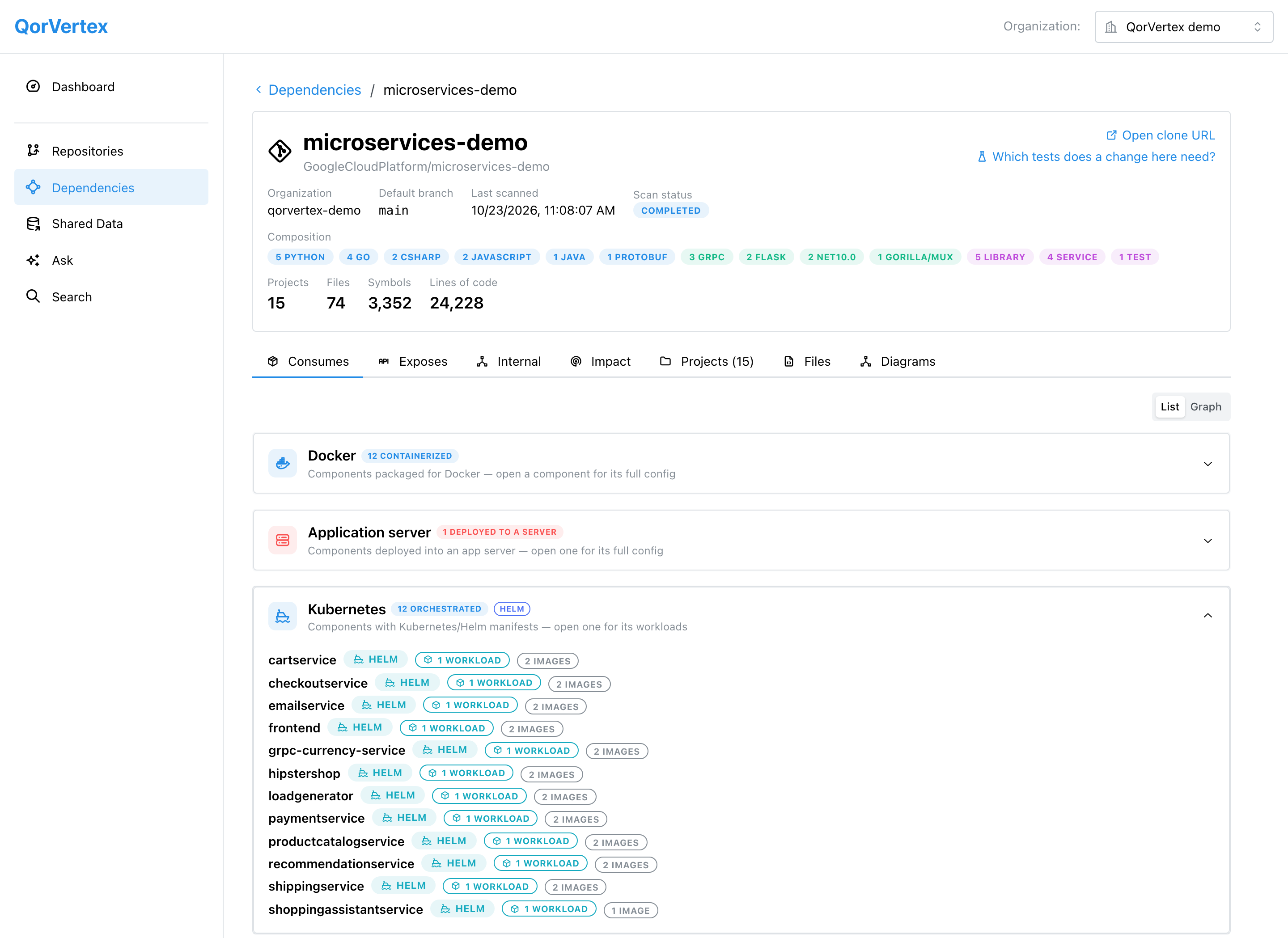
Google’s microservices-demo, one repository of 15 projects in five languages: every container, Kubernetes workload, package and API it depends on, read from the code.
Open it in the live demo →
8Languages
4VCS providers
5API protocols
10Message brokers
15ORMs & migrations
Ask it anything
AI that answers from all of your code, not a guess.
A coding assistant sees the repository you have open. QorVertex’s AI works from the map of every repository, so it can answer the questions that cross them, and it shows the file and line behind every claim. See how it works →
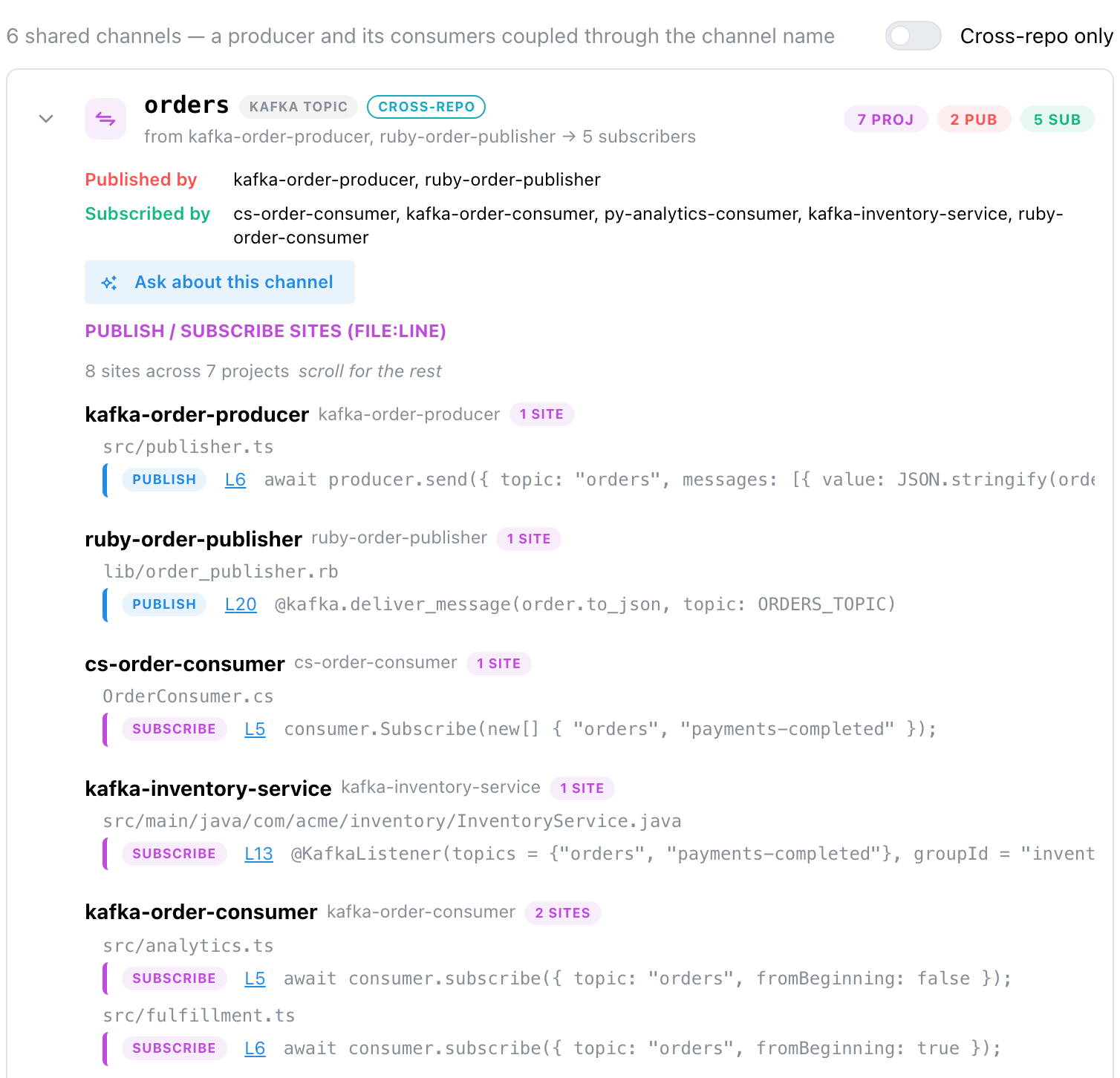
Recorded on the live demo. Asked “What breaks if the orders topic changes shape? Show the file:line for each.”, it runs 20 queries, then names all 7 repositories in 5 languages that share that topic by name alone, each with its file and line. The wait while it works plays at double speed.
Ask inside QorVertex
Start from whatever is on your screen, a class, a file, a message channel or a blast radius, and ask about it. Every answer shows the queries it ran, and exports as a report. The model runs in your cloud account, on AWS Bedrock or Google Vertex AI; nothing is sent to us.
Your cloud, your governance
Or inside the assistant you already use
An MCP server gives Claude Code, Cursor and GitHub Copilot the same map, so they can answer about repositories they have never opened, citing file and line. No model provider needed: your assistant brings its own.
9 read-only tools
On real code
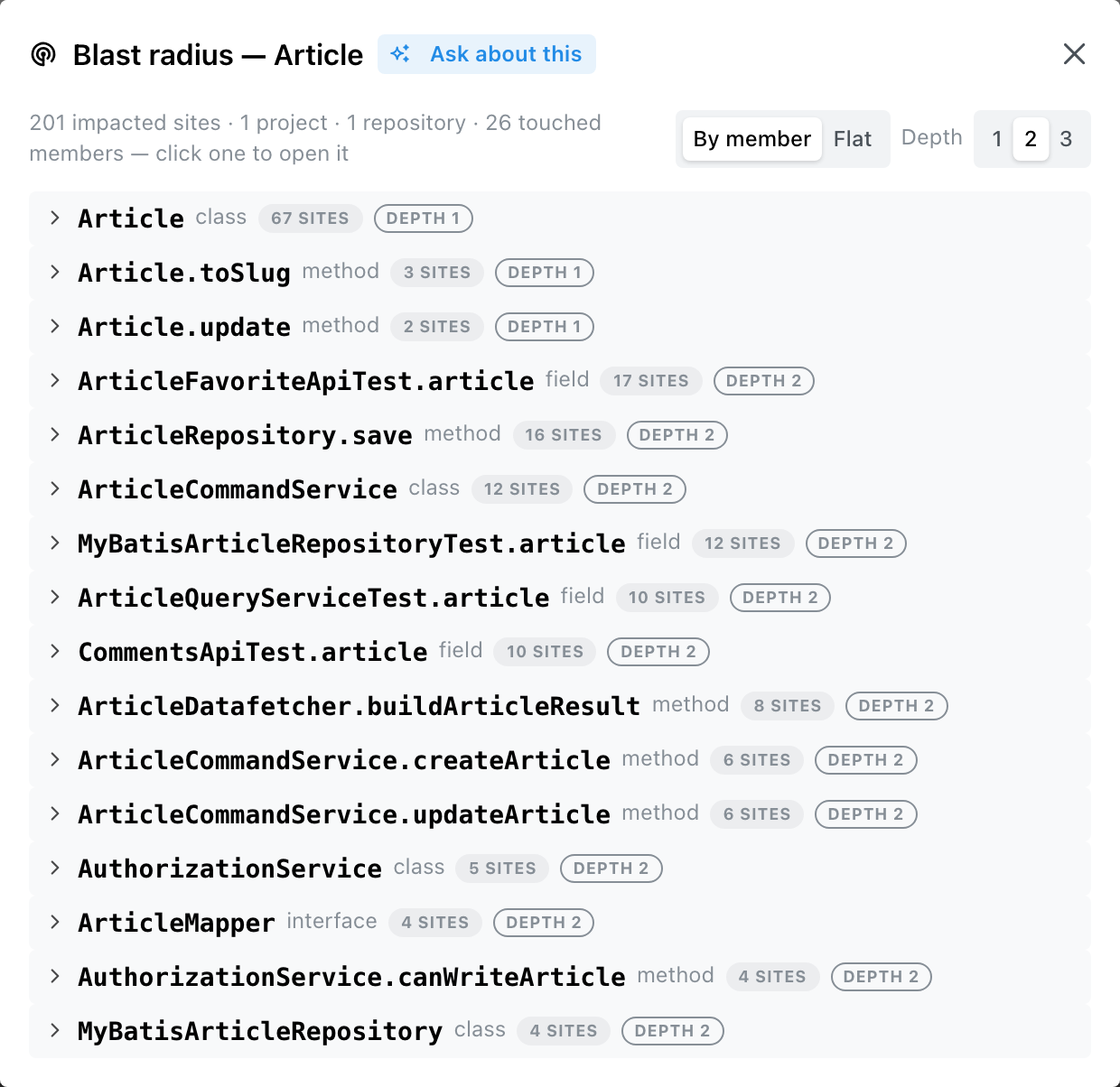
One class. 201 places it reaches.
This is Article, a class in the open-source Spring Boot RealWorld app, in our live demo. Ask what a change to it would touch, and QorVertex lists 201 places within two hops: the classes that import it, the services and data-access code that use those, and the tests that exercise them, each with its file and line.
The answer came back in under half a second. On your own code the same walk keeps going across repositories, APIs, message channels and shared tables.
In the demo, open Article.java, right-click the class name and choose Show blast radius, depth 2. Open it in the live demo →
The blind spot
The dependency your tools pretend isn't there.
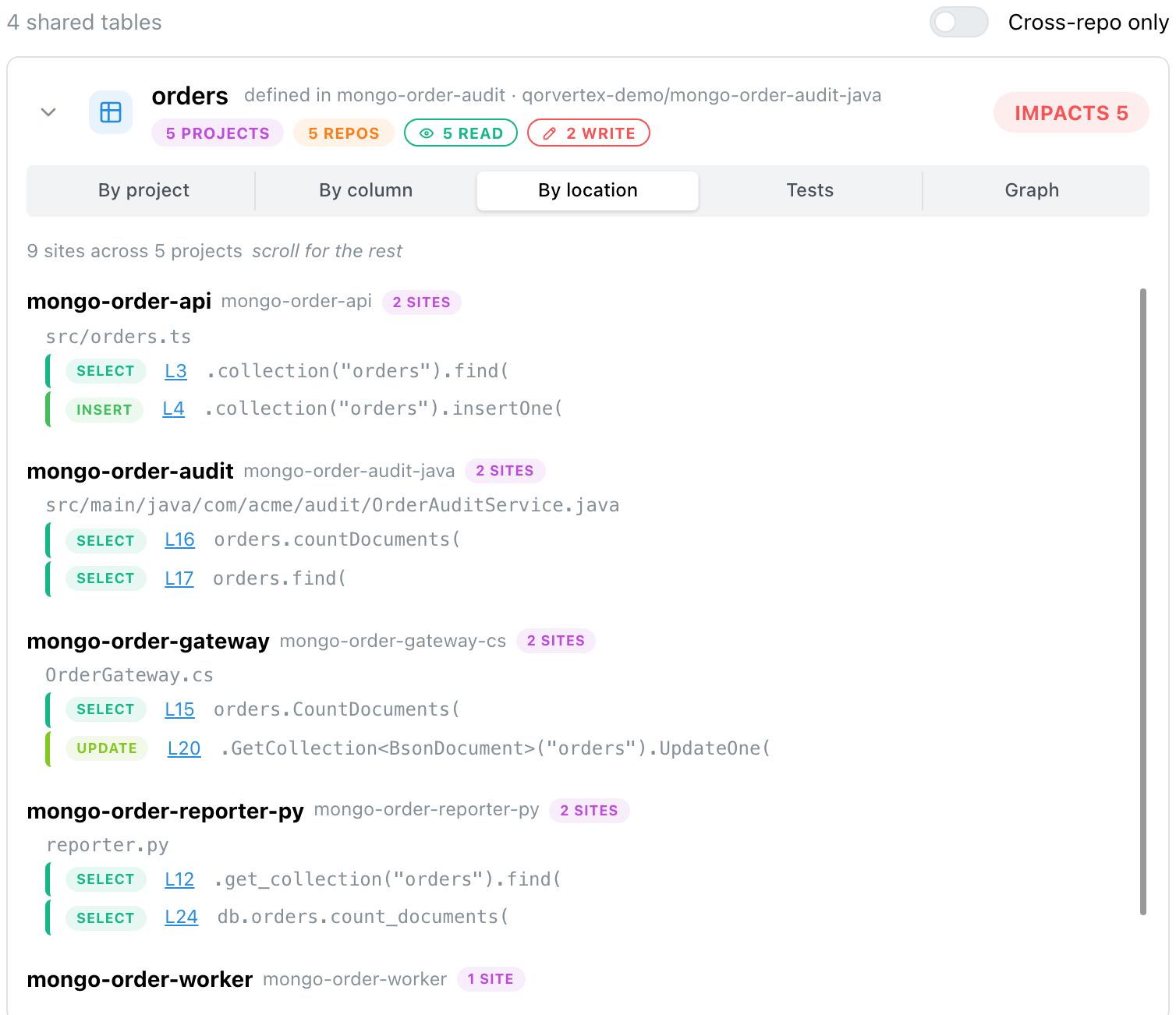
A change to one shared orders collection reaches five services in five repositories, and nothing in your IDE will warn you, because those services never reference each other in code. They only share a name.
QorVertex scans every repo into one catalog and treats shared tables, stored procedures, and message queues as first-class dependencies. So the coupling becomes something you can see, search, and measure.
→
Shared tables couple N projects across repos — with per-column blast radius.
→
Physical database identity, not just table names — two unrelated users tables aren't falsely coupled.
→
Works across languages: one node can join JS, Python, Java, and C# services.
QorVertex scans every repository and works out what connects them: the calls, the APIs, the message channels and the shared tables. People explore that map directly; AI answers from it, so it can cite where every answer came from. Explore the product →
Multi-repo scanning
Pull every repository across GitHub, GitLab, Bitbucket, and Azure DevOps into one catalog. Auto-rescan on check-in — no public webhook required.
4 VCS providers
Cross-repo dependency graph
Calls, imports, inheritance, and type bindings resolved across project and repository boundaries — with durable edges that survive partial rescans.
The core
Database as a dependency
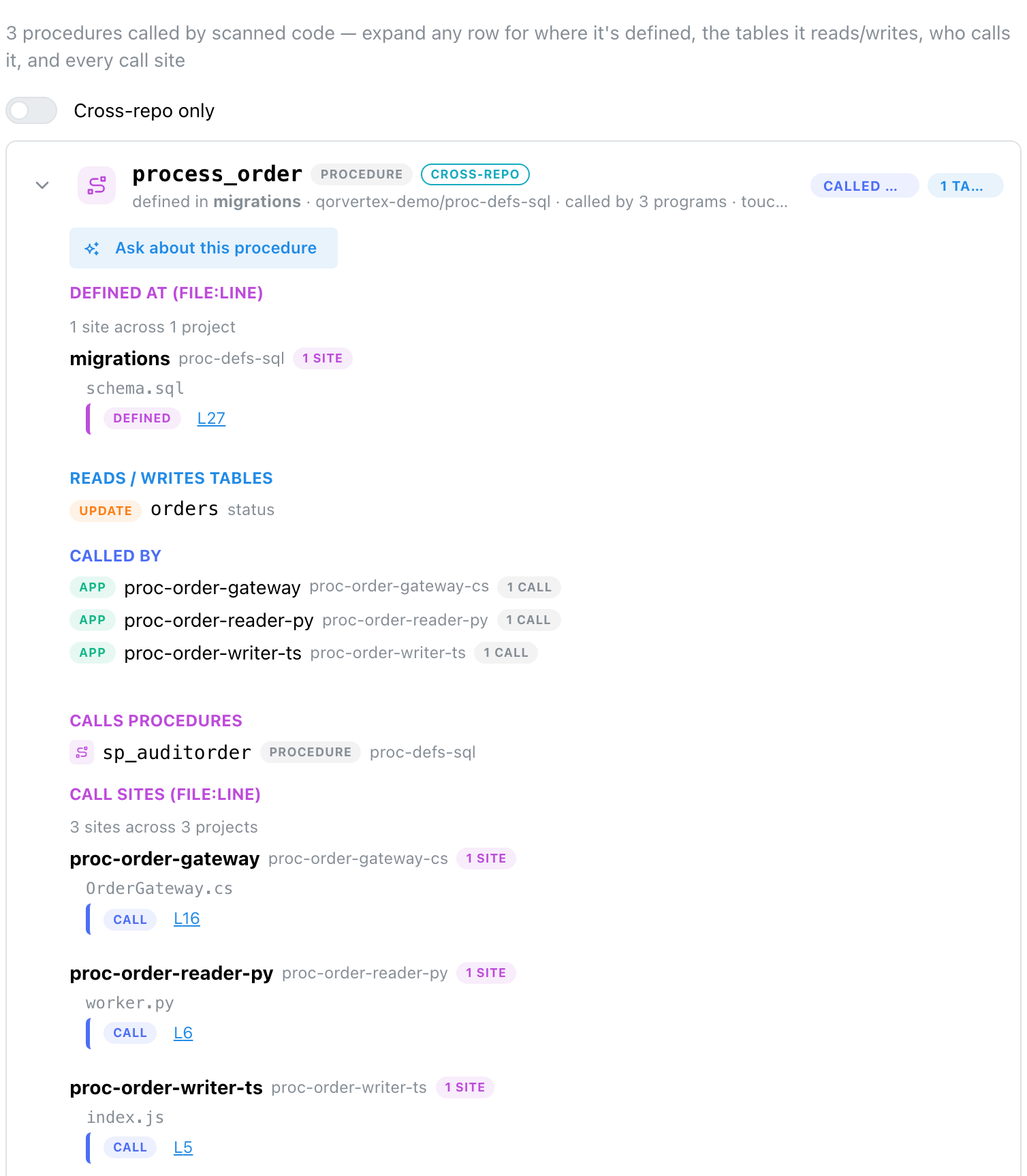
Shared tables, stored procedures, and physical databases as first-class nodes — with per-column blast radius and cross-language coupling.
Shared Data
API surface mapping
Who exposes and who consumes each endpoint — REST, gRPC, GraphQL, MCP, and SOAP — with "Called by N" across every repo.
5 protocols
Event & messaging coupling
Publishers and subscribers linked through channel names across 10 broker families — Kafka, RabbitMQ, SNS/SQS, Pub/Sub, Sidekiq, JMS, and more.
10 broker families
Impact & blast radius
Walk dependents transitively from any symbol, table, column, endpoint, or event. Answer "what breaks if I change this?" before you commit.
Change safety
Visualization
UML class and component diagrams, container diagrams, React component trees, dependency graphs and shared-table data-flow views, all drawn from the code, with full version history, diff, and restore. See one →
Diagrams
Org-wide search
Find any class, function, table, endpoint, or package — and every place it's used across all repos, ranked by real usage.
Find anything
Works in your editor
An MCP server that lets Claude Code, Cursor, and Copilot answer about repositories they have never opened — with file:line. No model provider needed; your assistant brings its own.
9 read-only tools
Test impact analysis
Which integration and end-to-end suites must run for this change — across repositories. Always a minimum, never an allow-list: what can't be analysed says run everything.
Run less, safely
Shared schema contracts
An industry XSD, WSDL, or proto compiled into many products couples them by name alone. Trace a schema type through the generated class to every line of code that touches it.
XSD · WSDL · Protobuf
Deployment topology
What a component is deployed into, and what it talks to at run time — Docker Compose, Kubernetes and Helm, JBoss, WebLogic, IIS — wired into the same blast radius.
Compose · K8s · app servers
See it
From "who touches this?" to a straight answer.
The blast radius of a single column change, walked across services and back to the code that calls it. Explore it live → — no signup, a curated public catalog.
It speaks your languages, frameworks, and platforms.
From source and APIs to databases, message brokers, and how it all deploys — coverage is what makes an org-wide graph possible. See the full list →
TypeScript
Python
JJava
C#C#
Go
PHP
Ruby
Spring Boot
ASP.NET Core
React
Django
Laravel
Ruby on Rails
gRgRPC
GraphQL
Kafka
RabbitMQ
Redis
PostgreSQL
MSSQL Server
MongoDB
Prisma
Docker
Kubernetes
Helm
JBoss / WildFly
Tomcat
GitHub
GitLab
Solutions
The questions no single-repo tool can answer.
"Where is this used across all our repos?"
Search any symbol, table, endpoint, or package and see every consumer, grouped by repository — not just the ones in the file you're looking at.
→ Org-wide search & dependents
"What breaks if we change this interface, table, or event?"
Walk the blast radius transitively — through shared columns, procedures, and message channels — before the change ships.
→ Impact analysis
"Which projects depend on this shared library, table, or topic?"
Every producer and consumer of a shared node, across repositories and languages, on one page with read/write breakdown.
→ Shared Data
How it works
Point it at your repos. Then ask it anything.
STEP 01
Connect & scan
Add your source connections. QorVertex clones and parses every repository — TypeScript, JavaScript, Python, Java, C#, Go, PHP, and Ruby, tree-sitter accurate — into a central PostgreSQL catalog.
STEP 02
Resolve across boundaries
Symbols, APIs, events, and database access are resolved into shared nodes, so a table or endpoint many services touch becomes one thing they all point at.
STEP 03
Ask, explore & assess impact
Ask in plain English, search, walk the graph, and measure the blast radius of any change. Auto-rescans keep the map current as code lands.
Self-hosted
Runs in your infrastructure. Not SaaS.
One downloadable bundle, one install.sh. It provisions the whole stack behind an nginx ingress on a single Linux box — your source and your catalog never leave your network.
AES-256-GCM credentials at restJWT auth · admin / user rolesOptional built-in TLSHealth self-monitoring
# download the bundle, then
tar xzf qorvertex-v1.1.0.tar.gz
cd qorvertex-v1.1.0
sudo ./install.sh
# → stack up · migrations applied · admin ready
Pricing
Metered by the code you scan.
Self-hosted at every tier. Start free, grow by lines of code analyzed.
Prices are placeholders — tiers are being finalized. Metering is by lines of code scanned. During the early adopter program, selected organizations get a 90-day evaluation; the free tier opens at general availability.
Give your AI the whole codebase.
Apply to the early adopter program and we'll help you install QorVertex on your own code. See your organization's real dependency graph — database included.